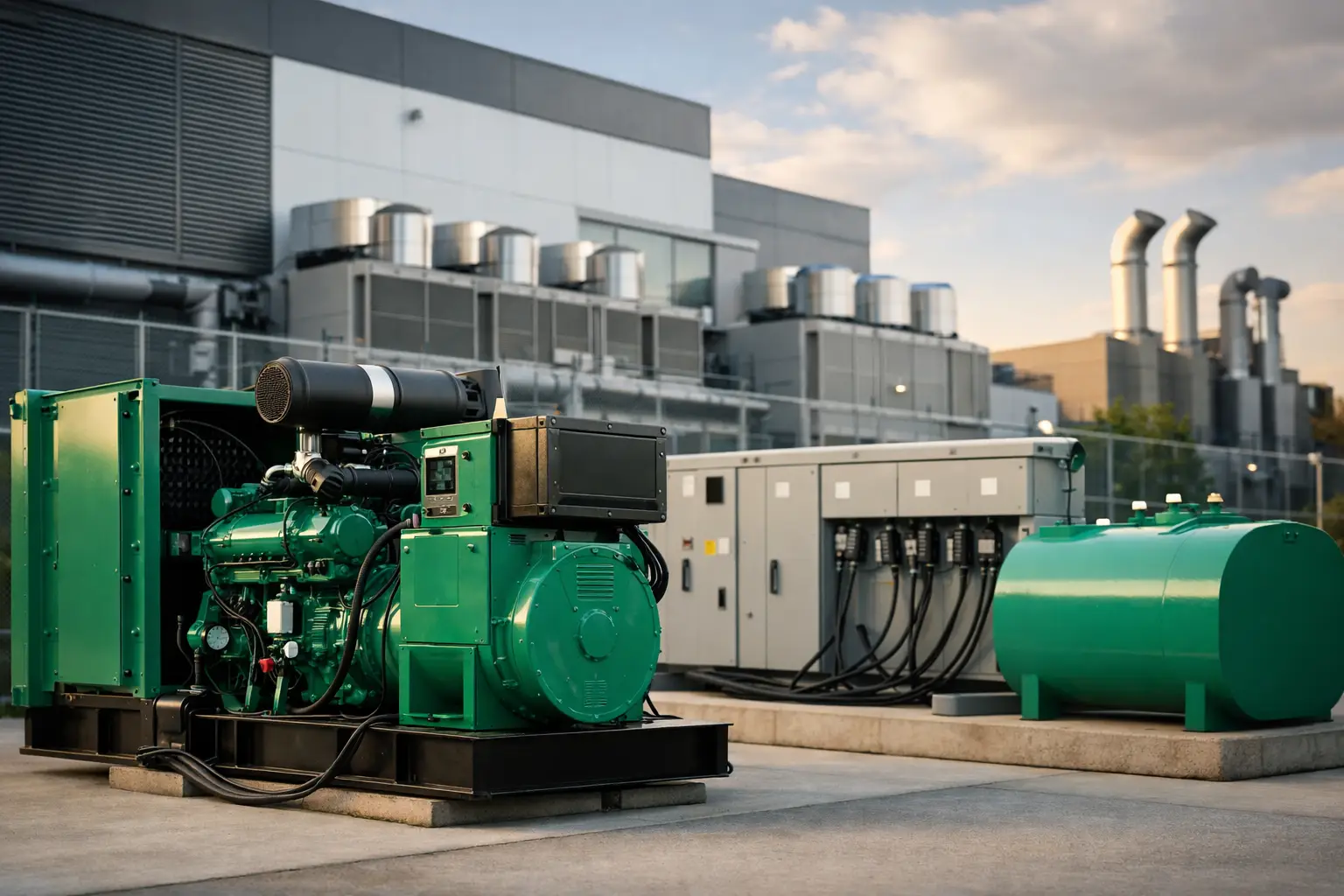
A generator that runs comfortably during a routine test can still fail when the site needs it most. The usual cause is not a defective alternator or engine. It is an incomplete generator load calculation that overlooks motor starting current, phased loads, power factor, future expansion or the difference between standby and prime operation.
For facilities, plant and infrastructure teams, the objective is not simply to total every nameplate rating. It is to specify a generator set that will accept the real operating load, start the most demanding equipment, maintain acceptable voltage and frequency, and provide the required duty for the site. Oversizing has a cost. Undersizing has consequences: failed starts, nuisance trips, unstable voltage, engine stress and avoidable downtime.
What a generator load calculation must establish
A sound calculation produces more than a headline kVA figure. It identifies the site's maximum demand, the order in which loads are applied, the electrical characteristics of major equipment and the generator rating required for the intended operating duty.
Start with the load that will actually be supported. On a standby system, this may mean life-safety circuits, critical process equipment, server rooms, pumps, refrigeration, emergency lighting and selected production loads rather than the entire incoming supply. For a prime power installation, the calculation should reflect normal operating demand over time, including daily peaks and expected running hours.
Every connected item should be recorded with its rated power, voltage, phase, power factor and starting method. Existing distribution schedules are useful, but they should be checked against site surveys and operational knowledge. A board may contain circuits that are no longer used, while a critical machine may have been added without an updated schedule.
The calculation also needs to distinguish between running load and starting load. A 30 kW motor may be straightforward once running, yet impose a substantially higher demand when started direct-on-line. That transient can determine the generator size even where the normal running total appears modest.
kW, kVA and power factor
Generator sets are generally rated in kVA, while much of the site equipment is described in kW. The relationship is straightforward:
kVA = kW ÷ power factor
At a power factor of 0.8, a 100 kW load requires 125 kVA. This is why adding kW values and selecting the nearest equivalent kVA generator can be misleading. The actual site power factor matters, particularly where the installation includes motors, variable speed drives, UPS systems, welding equipment or other electronic loads.
A generator's published kVA rating is normally based on a defined power factor. It does not mean every load profile can be carried without assessment. Low power factor can increase alternator current demand. Leading power factor, which may arise from lightly loaded capacitive systems or incorrectly managed correction equipment, can also create voltage control issues.
For three-phase systems, load balance is equally relevant. Large differences between phases can limit usable capacity and affect voltage quality. A 3 phase generator should be assessed against the heaviest phase, not only the combined total. Single-phase loads may need to be distributed across the system or supported by a separate single phase arrangement where appropriate.
Build the load schedule before selecting a set
The most dependable approach is to build a load schedule and validate it with the people who operate the site. The schedule should separate essential from non-essential demand and show which loads start automatically after a mains failure.
For each item, capture the running kW or kVA, power factor, quantity, duty cycle and starting requirement. Major loads deserve individual treatment. These commonly include fire pumps, borehole pumps, compressors, ventilation fans, lifts, chillers, conveyors, cranes, refrigeration plant and large UPS inputs.
Do not assume every item runs at full nameplate load at the same time. Diversity can be legitimate where operational sequencing proves it. However, diversity should never be used to reduce a load that is known to run simultaneously during an emergency or production cycle. The test is simple: can the proposed generator carry the worst credible operating condition, rather than an optimistic average?
A practical load schedule should also identify loads that can be delayed. If non-essential ventilation, electric heating or secondary process equipment can be introduced several minutes after the generator has stabilised, an automatic load-shedding or staged transfer strategy may reduce the set size required. This needs to be engineered into the control scheme, not left as an informal operating instruction.
Motor starting often sets the generator size
Motor loads are where many generator selections fail. Direct-on-line starting can draw several times the motor's full-load current. The generator must have sufficient alternator capability and engine response to support that demand without an unacceptable voltage and frequency dip.
Starting method changes the result. Star-delta starters, soft starters and variable speed drives may reduce starting current, but each brings its own considerations. A soft starter lowers inrush but may extend the start period. A variable speed drive can reduce mechanical and electrical starting stress, yet its rectifier input may introduce harmonic current. UPS systems and electronic power supplies can have similar effects, especially where a generator is lightly loaded or the input characteristics are poorly matched.
The starting sequence is therefore as important as the individual load. Starting a large pump after the generator has accepted lighting and controls may be acceptable. Starting two large pumps together may not be. For sites with high-inertia loads, pump duty requirements or strict voltage tolerances, generator sizing should be checked using manufacturer data and transient performance analysis rather than a basic multiplier alone.
Select the correct duty rating
Generator load calculation must be aligned with the correct rating category. Standby power is intended for emergency operation during utility failure. It is not automatically suitable for continuous or regular commercial generation.
Prime power is for variable load applications where the generator may be the main source of supply for extended periods. It is common on remote sites, construction projects, temporary utilities and locations with unreliable mains power. Prime-rated sets should be assessed against the expected load profile, average loading, maintenance intervals and fuel autonomy.
The same physical generator can have different standby and prime ratings. Selecting against the higher standby figure for a continuous duty application creates a specification risk. Procurement documents should state the intended duty clearly, along with annual operating hours, load variation and any requirement for parallel operation.
Allow for environment, installation and growth
Nameplate output is quoted under specified ambient conditions. High temperatures, altitude and restricted airflow can reduce available engine performance. A generator installed in a poorly ventilated plant room may not deliver the same output as the identical set operating in open air at standard conditions.
Enclosure type also affects the project. A silent generator is often required where noise limits, occupied buildings or urban boundaries apply. An open generator may suit a dedicated generator room or containerised installation, provided ventilation, exhaust routing, fuel systems and acoustic treatment are designed correctly. Neither format changes the need for a proper electrical calculation, but both can influence derating and final site performance.
Future capacity should be considered without selecting excessive unused power as a default. A reasonable allowance for a planned extension, an additional pump or increased server capacity can be sensible. A set that is materially oversized and rarely loaded can create operating inefficiency and, on diesel units, increase the risk of poor loading conditions over prolonged periods. The right allowance depends on the expansion plan and the likelihood of additional demand, not a fixed percentage applied to every project.
Verify the calculation against real operating conditions
A calculation should be followed by commissioning tests that reflect the intended duty. Resistive load-bank testing proves that a set can produce a defined load, but it does not always replicate the site behaviour of motors, drives and staged transfers. Where practical, test the actual critical load sequence and record voltage, frequency, current and recovery during motor starts.
Review the result after major changes to the facility. New process machinery, HVAC upgrades, expanded battery charging, additional IT equipment and altered operating patterns can all invalidate an older assessment. Critical power capacity is not a one-time procurement exercise. It is an operational control that should remain aligned with the site.
Global Generators can support specification discussions across standby and prime power requirements, with generator sets available from 13 to 3000 kVA in silent, open, single-phase and three-phase configurations. A clear load schedule and starting sequence will make that discussion faster and produce a more reliable result.
The best generator selection is one that performs predictably on the worst day, with the actual loads the site must keep running. Start with measured demand, account for starting conditions and duty rating, then specify the set around the operational risk you cannot afford to carry.