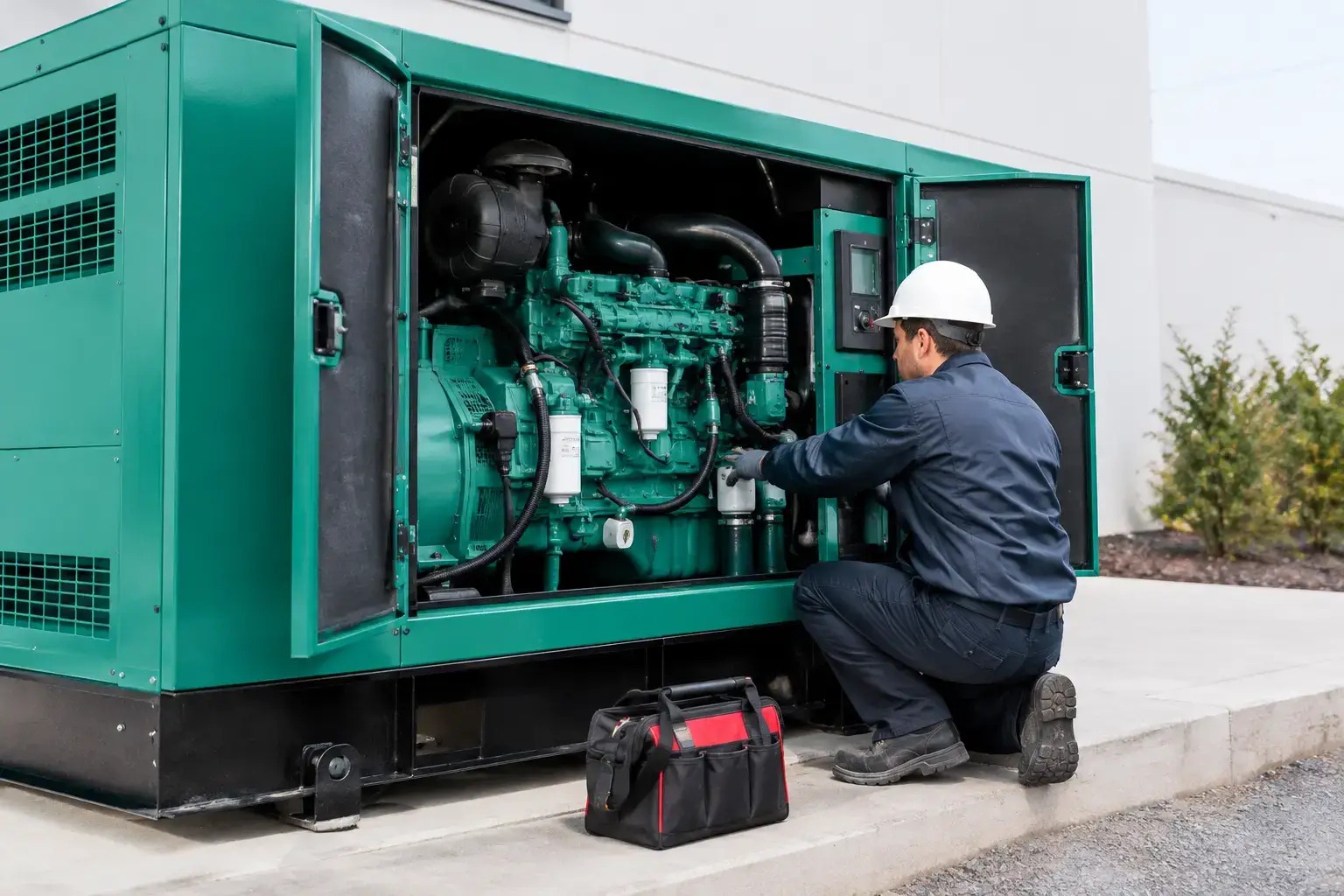
A standby generator can appear ready for years, right up to the moment a mains failure exposes a weak battery, contaminated fuel supply or transfer fault. For facilities where power loss stops production, affects safety systems or disrupts essential services, knowing how to maintain standby generators is an operational requirement, not a housekeeping task.
Maintenance should be planned around the generator set, its automatic transfer switch, the fuel system and the real duty expected during an outage. A well-specified diesel generator is only as dependable as the inspection, exercising and servicing regime behind it.
How to maintain standby generators for dependable uptime
The starting point is a written maintenance schedule based on the engine manufacturer's requirements, the generator's standby rating and the site's risk profile. A unit protecting a data room, care facility, telecoms installation or process plant deserves closer attention than a lightly used set serving non-critical office loads.
Assign clear responsibility for checks and make sure the appointed person can recognise faults, understand the controller and escalate issues promptly. Maintenance records should show operating hours, test duration, load achieved, fluid levels, battery condition, alarms, defects and corrective work. When an outage occurs, those records provide evidence of readiness and make recurring faults easier to identify.
Before working on any generator, follow site isolation procedures. Automatic-start equipment can start without warning after a mains failure, remote command or programmed exercise. Disable automatic operation where necessary, isolate the starting system and use competent engineers for electrical or fuel-system work.
Carry out routine visual inspections
A short, regular inspection catches many failures before they become expensive. Check the set for oil, coolant or fuel leaks, loose fixings, damaged hoses, worn belts and corrosion around terminals or pipework. Inspect the enclosure for water ingress, blocked ventilation, damaged acoustic panels and anything restricting airflow around the radiator or alternator.
Look at fuel and coolant levels, but do not treat a full tank as proof that the fuel is usable. Water, microbial growth and sediment can accumulate in diesel tanks, particularly where fuel remains stored for long periods. Check tank bunds, vents, gauges, supply and return lines, and drain water separators where fitted.
The generator room or external compound also needs attention. Keep access clear, maintain adequate ventilation and ensure exhaust discharge is unobstructed. Rubbish, packaging, stored materials and vegetation can create overheating, fire and access risks. On outdoor installations, inspect the canopy, doors, seals, louvers and exhaust weather cap after severe weather.
Exercise the generator under a meaningful load
Regular exercising confirms that the engine starts, the controller responds and the generator produces power. However, a brief no-load run does not prove the set can carry the site when it matters. It may also allow lightly loaded diesel engines to run too cool, increasing the risk of carbon build-up and wet stacking.
Use the programmed exercise function where appropriate, but periodically test the complete emergency power sequence. This should include a simulated mains failure, automatic transfer switch operation, generator acceptance of load and stable return to utility supply. Record start time, frequency, voltage, oil pressure, coolant temperature, battery charging voltage and any controller alarms.
The right test load depends on the installation. Testing against the actual building load is useful because it proves the complete system, including the transfer arrangement and distribution. A load bank is often preferable where the site load is too low, too variable or too sensitive to interrupt. It allows the generator to be assessed at a controlled percentage of its rated capacity without placing the facility at risk.
Do not assume the standby rating can be used continuously. Standby power is intended for emergency operation with defined operating limits, whereas prime-rated sets are designed for variable-load, extended-duty applications. The duty classification, kVA rating and expected load profile must align before a maintenance test programme is set.
Protect the fuel system
Fuel is one of the most common causes of standby generator failure because it is frequently ignored until an emergency. Diesel can degrade during storage, while condensation introduces water that encourages microbial contamination. Blocked filters, injector problems and tank sludge can then prevent starting or cause the engine to stop under load.
A fuel management programme should include periodic sampling and analysis, particularly for larger bulk tanks or sets expected to stand for long periods. Arrange fuel polishing or tank cleaning when testing identifies water, particulate contamination or microbial activity. Replace fuel filters in line with the engine service schedule and investigate repeated filter blockage rather than simply fitting another element.
Keep enough usable fuel for the site's realistic outage requirement, not merely enough to fill the tank. Consider consumption at the anticipated load, refuelling access during poor weather or regional disruption, and whether other emergency systems draw from the same supply. Fuel autonomy should be reviewed whenever the protected load changes.
Keep batteries and starting circuits in serviceable condition
Most failure-to-start events trace back to batteries, battery chargers, cabling or starter circuits. Check battery terminals for corrosion, confirm connections are tight and inspect cables for damage or heat deterioration. Verify that the mains-powered battery charger is operating correctly and that the generator controller records the expected charging voltage.
Battery voltage alone is not a reliable measure of starting ability. A battery can show acceptable voltage and still collapse under cranking load. Conduct condition testing at planned intervals and replace batteries on condition or according to the supplier's recommended service life. On critical installations, consider the resilience of chargers, starting arrangements and any duplicate starting batteries.
Also test emergency stop circuits, start relays, heater supplies and engine jacket-water heaters where installed. A failed heater may not stop the engine starting, but it can lengthen start time and increase mechanical stress during cold conditions.
Service fluids, filters and cooling components
Scheduled servicing remains essential even when running hours are low. Oil degrades with time as well as use, and filters can deteriorate or become contaminated while the generator is on standby. Follow the engine manufacturer's intervals for oil, oil filters, fuel filters, air filters, coolant and drive belts, adjusting the programme for harsh environments, frequent testing or extended operation.
Cooling faults deserve particular attention. Check coolant concentration and condition, radiator cleanliness, hose integrity, fan operation and the condition of the water pump area. A blocked radiator or leaking hose may only become apparent once the set is carrying substantial load. For installations in dusty yards, construction environments or coastal locations, inspection intervals may need to be more frequent.
Use approved lubricants and coolant types. Mixing incompatible coolant products or topping up with untreated water can lead to corrosion, scaling and premature component failure. Record all fluid additions, as repeated top-ups often indicate a leak that requires investigation.
Test the transfer switch and controls
The generator does not protect the site unless the transfer system operates correctly. Inspect the automatic transfer switch, control wiring, sensing circuits and interlocks as part of the same maintenance plan. Confirm that the system detects a utility failure, sends the start command, transfers load only after the generator reaches acceptable voltage and frequency, then returns the site safely when utility power is stable.
Controller alarms should be reviewed rather than cleared without investigation. Low battery voltage, failed start, high coolant temperature, low fuel level and charger faults are early warnings. Remote monitoring can improve response times, but it does not replace physical inspection or competent servicing.
Any changes to building load, distribution boards, UPS systems or fire-safety arrangements should trigger a review of generator settings and capacity. A set that was correctly sized five years ago may no longer support the actual essential load.
Use competent service support and act on defects
In-house teams can manage routine inspections and testing where they are trained and authorised, but planned engine and alternator servicing should be completed by competent generator engineers. This is particularly relevant for high-kVA installations, synchronised systems, hospital or life-safety applications and sites with complex controls.
Treat defects according to their effect on availability. A cosmetic enclosure repair can be planned; a weak starting battery, fuel contamination, coolant leak or transfer-switch alarm needs prompt action. Deferring small faults is how standby systems become unreliable systems.
For sites with no tolerance for power interruption, the maintenance plan should be reviewed after every genuine outage and major test. Global Generators can support specification-led discussions where a generator's rating, configuration or current condition no longer matches the load it is expected to protect. The useful standard is simple: when mains power fails, the set should start, transfer and carry the required load without requiring anyone to improvise.