Quick answer
A care home generator should be sized for the loads that keep residents safe and comfortable, not for the whole building. That usually means lifts, hoists, nurse call and IT, heating pumps, lighting, medication and food refrigeration, and part of the kitchen. The three illustrative load lists in this guide come to about 24 kW, 31 kW and 107 kW, which point to a 50 kVA set for small and medium homes and a 200 kVA set for a large one. Keep the typical load under about 80% of the prime rating, choose automatic start with a properly specified transfer switch, and test it on load regularly. Regulators set outcomes, such as safe premises and equipment and risk assessment, and leave the method to the provider.
This guide explains what a standby generator needs to run in a care home, how to size one from a load list, what the regulations and local guidance say, and how to plan the automatic start, fuel and testing. It is general guidance. Your own risk assessment, your electrician and your regulator's requirements decide what your home needs.
What a power cut does to a care home
The Energy Networks Association (ENA) publishes power cut guidance for care and assisted living providers, including ten steps to be winter ready. Read as a list of what can stop, it covers:
- Communications. Telephones without a mains plug, switchboards, and the devices staff use to call for help. Mobile service can be limited or absent during a power cut.
- Medical and mobility equipment. Backup for medical equipment, air beds, ceiling hoists and stairlifts. The ENA notes that stairlifts often have backup batteries but that you should check how long they last.
- Piped oxygen. The ENA suggests considering backup generator support for piped oxygen, either a hired solution that connects through a pre-wired connection or a permanent hard-wired one.
- Security. Mains-operated doors and shutters. The ENA asks whether you can override them manually if they lose power, and says to check with your installer.
- Planning. Review your business continuity plans, and if you already have a backup generator, check that it meets the power needs and connections you would have to support in an emergency.
The ENA also explains that in the unlikely event of an energy shortage, rota power cuts could leave areas without power for around three hours once or twice a day. So a plan needs to cover repeated outages, not only a single one. Protected status is not automatic. Organisations have to apply and meet strict government criteria.
What the regulations say
In England, care homes are regulated by the Care Quality Commission. Two of its regulations bear directly on power resilience:
- Regulation 12: Safe care and treatment requires providers to assess the risks to service users' health and safety, and to ensure that premises and equipment are safe for their intended purpose and used in a safe way.
- Regulation 15: Premises and equipment requires premises and equipment to be clean, secure, suitable, properly used and properly maintained. Its guidance expects providers to have operational policies, procedures and maintenance budgets so that mechanical engineering and electrical systems are sound and operationally safe, to carry out regular health and safety risk assessments, and to have contingency plans where guidance cannot be met. It also says equipment such as beds, clinical equipment and moving and handling equipment must be available when needed.
These set outcomes. The regulation text and guidance we reviewed do not prescribe a generator, a size or a test frequency, and they leave the method to the provider. A standby generator is one common way to manage the risk that a power failure presents, alongside a business continuity plan and battery backups for critical equipment. Care homes in Scotland, Wales and Northern Ireland are regulated by their own bodies, so check the rules where you operate. Nothing here is legal advice, and no guide can promise how an inspector will judge your arrangements.
What should the generator run?
Start with a priority list. Typical loads for a care home:
| Load | Typical running load | Notes |
|---|---|---|
| Lighting and emergency lighting | 4 to 10 kW | Steady load |
| Heating pumps and boiler controls | 2 to 8 kW | Keeps heating running |
| Nurse call, fire alarm, IT and comms | 2 to 5 kW | Critical, constant |
| Passenger or bed lift | 5 to 10 kW each | Large starting surge |
| Kitchen (refrigeration plus cooking) | 8 to 30 kW | Cooking cycles on and off |
| Laundry | 10 to 15 kW | Can often be shed |
| Hoists, electric beds and small power | 2 to 8 kW | Varies through the day |
| Ventilation and air conditioning | 10 to 15 kW | High start-up surge |
Piped oxygen and other medical equipment need planning with your healthcare partners, because backup for them may be a separate arrangement. Decide what is essential and what can wait. Laundry and non-critical air conditioning are common candidates to shed, and a full commercial kitchen is rarely worth carrying in full.
Worked examples
These load lists are illustrative. Your own figures come from your equipment rating plates and your risk assessment.
A small home: about 24 kW
Lighting (4 kW), heating pumps (2 kW), alarms, nurse call and IT (2 kW), a lift averaging 5 kW, part of the kitchen (8 kW) and hoists and small power (3 kW) come to 24 kW. On a 30 kVA set with a 24 kW prime rating that is 100% load, which is too tight. A 50 kVA set with a 40 kW prime rating takes it at 60%.
A medium home: about 31 kW
Lighting (5 kW), heating pumps (3 kW), alarms and IT (3 kW), a lift averaging 8 kW, part of the kitchen (10 kW) and hoists and small power (2 kW) come to 31 kW. That is about 78% of a 50 kVA set's 40 kW prime rating and 70% of its 44 kW standby rating. It works, but a full commercial kitchen on top would not fit. Our guide to what a 50 kVA generator can run uses a care home as one of its examples.
A large home: about 107 kW
Lighting (10 kW), heating pumps (8 kW), alarms and IT (5 kW), two lifts averaging 8 kW each (16 kW), a kitchen (30 kW), laundry (15 kW), ventilation (15 kW) and hoists and small power (8 kW) come to 107 kW. That is about 86% of the 124 kW prime rating of a Cummins C170D5Q, which is tight, and about 67% of the 160 kW prime rating of a 200 kVA set. Shedding the laundry brings it down to 92 kW. For this size, look at our 150 kVA and 200 kVA ranges.
Which size for which home?
| Typical running load up to | Suggested size | Example model | Prime rating |
|---|---|---|---|
| About 19 kW | 30 kVA | Cummins C33D5 | 24 kW |
| About 32 kW | 50 kVA | Cummins C55D5EQ | 40 kW |
| About 38 kW | 60 kVA | Cummins C66D5EQ | 48 kW |
| About 99 kW | 150 to 170 kVA | Cummins C170D5Q | 124 kW |
Each figure is 80% of the prime kW rating. Our guides to what a 60 kVA generator can run and what a 20 kVA generator can run cover the sizes either side. For the method, see our guide to sizing a generator around critical loads.
Lifts, motors and starting loads
Lifts, pumps and compressors draw several times their running current for a moment as they start. As a rough guide, a motor started direct-on-line should be no more than about a third of the generator's kW rating, which is about 13 kW on a 40 kW set and 41 kW on a 124 kW set. If several lifts, pumps and kitchen compressors restart together after a transfer, the total surge can be much larger. Ask your supplier for the motor-starting capability of the exact set, and consider staging restarts.
> Expert tip: If you have more than one lift, ask your electrician whether they can be prevented from starting at the same moment after the generator takes over. Staged restart is far easier to design in than to retrofit.
Standby, not prime
A generator that only runs in emergencies and for testing is a standby application, and standby ratings are intended for that. Make sure the hours you expect, including test runs, sit within the cover. Our guide to prime versus standby power explains the difference, and the manufacturer's written warranty statement sets out how the hour limits work.
Automatic start and the transfer switch
Staff are on site around the clock, but a generator that waits for someone to start it adds delay and risk. Most care homes specify automatic start, where an automatic mains failure panel starts the generator and a transfer switch moves the building across.
- Our Cummins sets with the PowerStart 0600 controller list automatic mains failure functionality, remote start and fault logging.
- The generator, the mains supply and the transfer equipment must be designed as one coordinated system.
- Critical equipment such as nurse call, IT and alarms may still need a battery backup, because the generator takes time to start and take the load. The ENA describes a UPS as providing a few minutes of emergency battery backup to keep communications and computer equipment running.
Our guides to automatic versus manual transfer switches and generator ATS installation explain the options, and our guide to generator remote monitoring systems covers alerts for faults.
Fuel and run time
Plan for an outage that lasts longer than you hope. These figures use the Cummins datasheets for the sets above, with the load in each example. The 24 kW and 107 kW figures are interpolated between datasheet points.
| Example | Generator | Approx. fuel use | Tank | Approx. run time |
|---|---|---|---|---|
| Medium home, 31 kW | Cummins C55D5EQ | About 9.4 litres per hour at 75% load | 200 litres | About 21 hours |
| Small home, 24 kW | Cummins C55D5EQ | About 7.6 litres per hour at 60% load | 200 litres | About 26 hours |
| Large home, 107 kW | Cummins C170D5Q | About 33 litres per hour at 86% load | 400 litres | About 12 hours |
Run times use nominal tank capacity, so allow a reserve in practice. Larger tanks or separate fuel tanks extend autonomy, and our guide to how to calculate generator runtime shows how to work out your own figures. Keep stored fuel in good condition, as explained in our guide to generator fuel contamination, and agree a refuelling plan with your supplier before you need it.
Noise, siting and safety
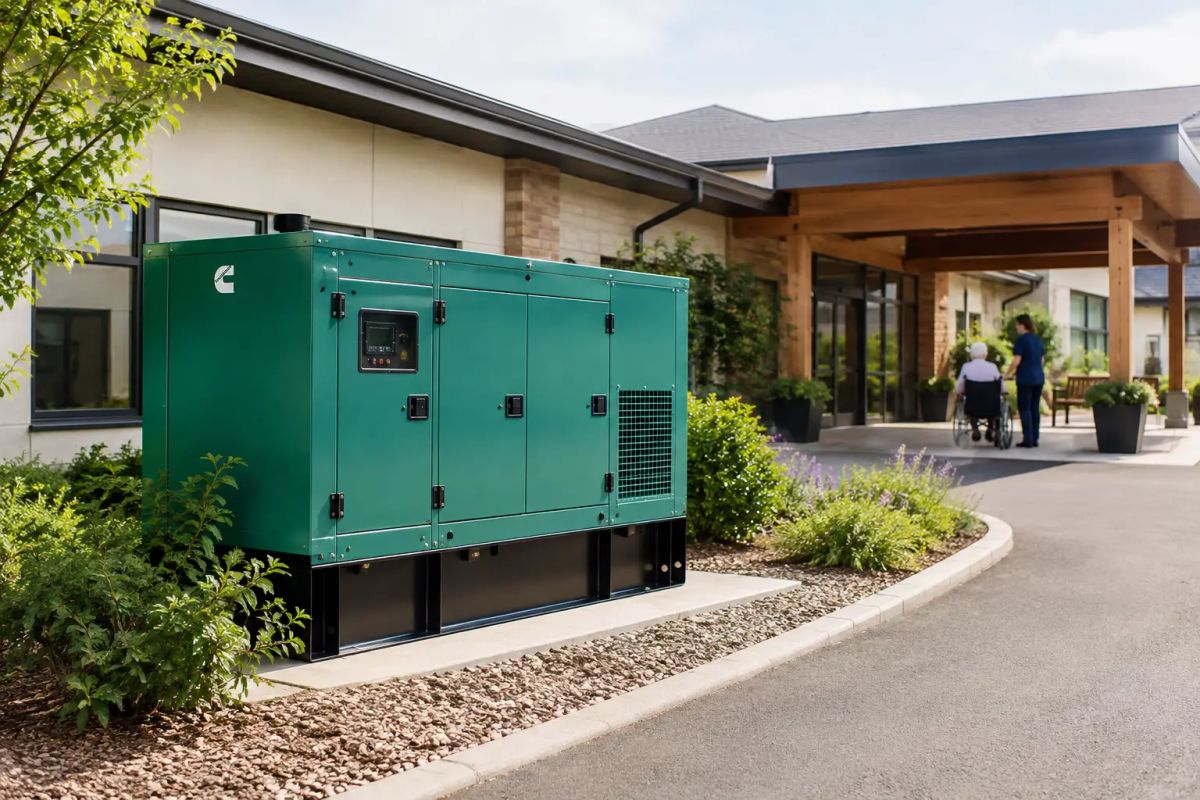
A care home generator sits close to residents' rooms, so noise and exhaust matter. Choose a canopied set, position it away from bedrooms and windows where possible, and never run a generator inside a building because diesel exhaust contains carbon monoxide. Our guide to how quiet a silent generator really is explains how to read the dB(A) figures, and you can browse our silent generators. The connection must be made by a qualified electrician through a proper transfer arrangement.
Test it, record it, keep it maintained
A standby generator only helps if it starts. Test it regularly and on load, keep dated records, and follow the manufacturer's service schedule, which also protects your warranty. The ENA also advises checking that an existing generator still meets the power needs and connections you would have to support in an emergency. Our guides to how often generators should be tested, generator load bank testing and our backup generator maintenance guide set out a routine. Some councils, such as Worcestershire, publish care home business continuity plan templates, which are a good place to record your power failure plan and your testing.
> Planning standby power for a care home? Tell us your priority loads, your lift details and how long you want to run, and we will help you size a set and plan the transfer arrangement. Use the contact page or call +44 1302 700200.
Common mistakes
- Sizing from the whole building, instead of a priority load list.
- Forgetting lift starting loads and staged restart.
- No plan for the gap while the generator starts, so critical equipment loses power.
- A manual-start set where automatic start is needed.
- Not testing on load, or not keeping records.
- No fuel plan for a long outage.
- Siting the generator badly, so noise and exhaust affect residents.
Frequently asked questions
Does a care home legally need a generator?
The CQC regulations we reviewed set outcomes, such as safe premises and equipment and risk assessment, and do not prescribe a generator. A standby generator is one way to manage the risk of a power failure. Your own risk assessment, business continuity plan and regulator decide what you need.
What size generator does a care home need?
It depends on your priority loads. The illustrative examples in this guide come to about 24 kW, 31 kW and 107 kW, which point to 50 kVA for small and medium homes and 200 kVA for a large one. Add up your own loads, keep the typical load under about 80% of the prime rating, and check lift starting loads.
Should the generator start automatically?
Usually, yes. An automatic mains failure panel and transfer switch start the generator and move the building across without waiting for someone to act. Critical equipment may still need a battery backup to cover the start-up gap.
What should a care home generator power?
The loads that keep residents safe: lifts, hoists, nurse call, IT and alarms, heating pumps, lighting, refrigeration and part of the kitchen. Laundry and non-essential air conditioning are common loads to shed.
How long will a care home generator run on a tank?
On a Cummins C55D5EQ with a 200-litre tank, about 21 hours at 75% load. On a C170D5Q with a 400-litre tank at 86% load, about 12 hours. Real loads and fuel reserves vary, so plan a refuelling arrangement.
How often should it be tested?
Regularly, and on load, with dated records. Our guide to how often generators should be tested sets out a routine, and your manufacturer's schedule applies for warranty.
Conclusion
A care home generator is part of safe care. Size it from a priority load list, allow for lift starting and a margin, specify automatic start with a properly designed transfer switch, and plan the fuel, siting and testing. Check what your regulator and your own risk assessment require, and keep records.
> Talk to a real person: Global Generators is an authorised Cummins reseller and an authorised Grupel and Pramac dealer, with new diesel generators in stock for UK delivery and export. Browse our standby generators or the stock list, then contact our team on +44 1302 700200 or at enquiries@global-generators.com and we will help you match a set to your home.