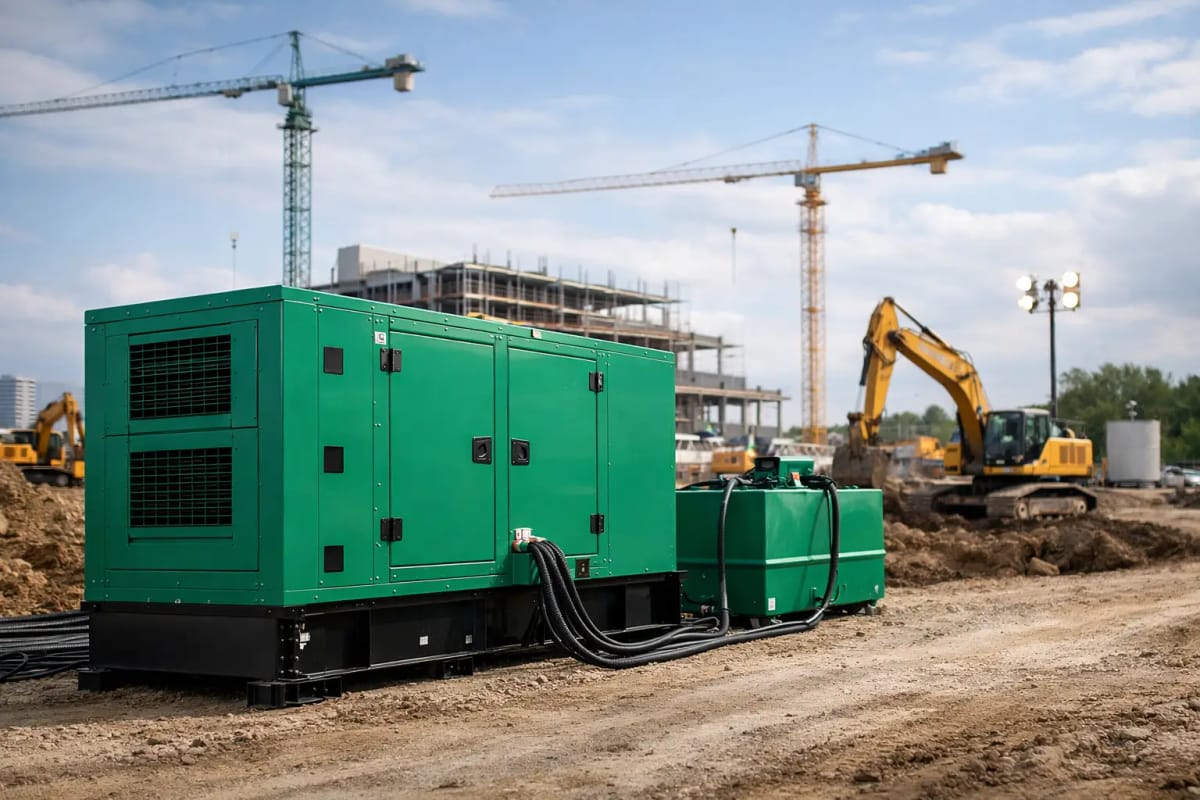
A generator that starts but cannot accept the site load is not a backup solution. Power generators must be specified around the equipment they will support, the duration of operation and the conditions at the installation. For facilities, construction projects and industrial operations, the cost of an undersized or incorrectly configured set is measured in lost production, unsafe shutdowns, missed service levels and avoidable replacement costs.
The right procurement decision begins with the duty requirement, then works through load profile, electrical configuration, environmental conditions and installation. A headline kVA figure is only one part of the specification.
Start with the required generator duty
The first decision is whether the generator is required for standby power, prime power or continuous operation. These ratings are not interchangeable, even where the engine and alternator are fitted within the same generator frame.
Standby power is intended for emergency operation during a mains failure. It is appropriate where the generator runs intermittently and carries a variable load for limited hours. Typical applications include commercial buildings, healthcare support systems, data rooms, retail sites and manufacturing facilities with an existing mains supply.
Prime power is for sites where the generator is the principal source of electricity, or where it will operate for extended periods with variable load. Construction compounds, remote operations, temporary infrastructure and sites subject to unreliable grid availability commonly require a prime-rated set. Prime operation places a greater sustained demand on the engine, cooling system and fuel arrangements, so the available rating is normally lower than the equivalent standby rating.
Continuous-duty requirements are more specialised. Where a set is expected to run at a steady load for long periods, the duty cycle, service intervals and fuel strategy need to be assessed as a complete operating plan. Selecting a standby-rated unit for regular prime operation may reduce reliability and compromise warranty conditions.
Size power generators for the real load
Load assessment should consider more than the total nameplate rating of connected equipment. A site may have motors, compressors, pumps, refrigeration, lifts, welding equipment, UPS systems, variable speed drives and non-linear loads. Each behaves differently when power is applied.
The generator must support both the running load and the highest expected starting or step load. Direct-on-line motor starts can create a significant short-duration demand. If several motors start together, voltage and frequency may dip beyond acceptable limits, even though the calculated running kW appears to be within the generator capacity.
A proper load schedule identifies each item, its running kW or kVA, power factor, starting method and whether it must run during generator operation. It should also distinguish essential and non-essential circuits. In many installations, load shedding is a more cost-effective way to protect critical functions than purchasing capacity for every possible load.
Power factor requires particular attention. Generators are generally rated in kVA, while much site equipment is discussed in kW. The relationship is simple in principle: kW equals kVA multiplied by power factor. In practice, the load mix and alternator capability determine whether a selected set will perform as required. A low power factor or high harmonic load can require a larger alternator or a generator designed for the application.
It is sensible to leave controlled capacity for future expansion, but excessive oversizing is not automatically safer. A diesel generator that consistently runs at very low load may experience poor combustion, wet stacking and unnecessary fuel use. The objective is an appropriate operating range, not simply the largest available set.
Assess the electrical arrangement
Voltage, phase and frequency must match the installation. Most industrial and commercial sites require 400/230V, 50Hz, 3 phase power, while smaller premises or dedicated loads may require single phase output. Three-phase sets can often supply single-phase loads, but phase balancing must be considered. Heavily loading one phase while leaving others lightly loaded can restrict usable capacity and affect performance.
The generator control system must also be compatible with the transfer arrangement. For standby installations, an automatic transfer switch detects a mains failure, starts the generator, transfers the load and returns the site to mains power when the supply has stabilised. Critical facilities may require synchronisation, parallel operation or staged load transfer rather than a simple changeover.
Choose an enclosure that suits the site
Open generators are suited to plant rooms, protected compounds or containerised installations where acoustic treatment and weather protection are already provided. They offer practical access for servicing and can be appropriate where sound limits are not a concern.
Silent generators use an acoustic canopy to reduce noise and provide weather protection. They are commonly selected for commercial premises, urban construction projects, logistics yards and sites close to occupied buildings. However, the enclosure specification matters. Noise level should be assessed at the stated distance and under the expected load, rather than accepted as a generic description.
For either configuration, installation conditions affect reliability. Airflow is essential. A generator room needs sufficient combustion air, cooling air intake and a clear discharge route for hot air. Poor ventilation can cause elevated operating temperatures and derating. Exhaust routing, fire protection, drainage, access for maintenance and safe refuelling should be addressed before delivery.
Environmental conditions can change the required specification. High ambient temperatures, altitude, salt-laden air, dust and extreme cold may require derating or additional protection. A generator intended for a clean internal plant room is not automatically suitable for an exposed industrial yard.
Fuel autonomy and maintenance are part of uptime
A generator is only available if it has usable fuel, a maintained starting system and a tested control sequence. Fuel tank capacity should be selected around the expected load and the required runtime, with allowance for site access during an incident. A set that delivers eight hours at a nominal load may provide materially different autonomy at the actual site load.
For critical standby systems, fuel quality management is as important as tank size. Diesel held for long periods can be affected by water ingress, microbial contamination and sediment. Routine inspection, fuel testing and filtration reduce the risk of an otherwise healthy generator failing when called upon.
Maintenance requirements should be practical for the site. Consider service access to filters, belts, batteries and fluid points, as well as safe access around the set. Remote monitoring can provide early warning of battery charger faults, low fuel, abnormal temperatures and alarm conditions, but it does not replace scheduled load testing and servicing.
Regular testing should reflect the actual duty. No-load starts confirm that the engine will run, but they do not prove that the generator can accept the intended load. Planned maintenance, on-load testing, or controlled load-bank testing where appropriate, provides more meaningful assurance.
Build a clear procurement specification
A concise, accurate enquiry enables faster and more reliable generator selection. At a minimum, the procurement brief should confirm:
- required standby, prime or continuous rating;
- voltage, frequency, phase and earthing arrangement;
- running load, starting loads and known non-linear equipment;
- required runtime and fuel tank arrangement;
- enclosure type, noise limits and installation environment;
- transfer switch, synchronisation, monitoring and delivery requirements.
Engine brand and component quality should also carry weight. Proven industrial diesel engines, matched alternators and established control systems support serviceability over the life of the installation. Buyers should compare like for like: rating basis, engine output, alternator specification, control panel capability, canopy construction and included accessories all affect the true value of a quoted set.
Match availability to the operational deadline
For urgent replacement projects and time-sensitive works, availability is often as significant as the technical specification. A correctly sized generator that cannot be delivered within the project programme does not resolve the immediate risk. Stocked power ranges, confirmed lead times and clear delivery arrangements should be established before equipment is committed to site.
Global Generators supplies diesel generator sets across 13-3000 kVA, including silent and open configurations, to support both standby and prime power requirements. The strongest result comes from matching the set to the site rather than forcing the site to fit the set.
A dependable generator installation is built before the engine starts: through accurate load data, the correct duty rating, practical fuel planning and a configuration that can be maintained under pressure. When those decisions are made early, power continuity becomes an engineered outcome rather than an assumption.