Quick Answer
A genset - short for “generator set” - is a complete, self-contained power generation unit combining an engine, an alternator, a fuel system, and control electronics, built to produce electricity independently of the main utility grid. “DG set” (diesel generator set) refers specifically to gensets powered by diesel engines, the most common type for commercial and industrial standby and prime power. The terms genset and DG set are used interchangeably across most of the world, though regional preference varies - “DG set” is especially common across India, Nigeria, Pakistan, and the Middle East, while “diesel generator” is more typical UK and US phrasing for the same equipment.
What Does “Genset” Actually Mean?
“Genset” is short for generator set — a term that reflects what the equipment actually is: not a single component, but a complete assembly of parts working together to generate electrical power. A genset isn’t just an engine, and it isn’t just an alternator. It’s the full package, engineered and tested to work as one unit.
This matters more than it might sound. Diesel gensets are designed, rated, and sold as a single system — engine, alternator, control panel, fuel system, cooling, and enclosure all matched to work together reliably. If you want the full technical breakdown of how this equipment is engineered and where it fits on a site, we cover that in detail in our diesel generator set guide. Buying mismatched individual components and assembling them yourself is a very different (and generally far less reliable) proposition than buying a factory-built, tested genset.
Where Does “DG Set” Come From?
DG set stands for diesel generator set, and it’s simply a more specific version of the same term — a genset that’s powered by a diesel engine specifically, as opposed to petrol, gas, or another fuel type.
Diesel is by far the most common fuel choice for commercial and industrial backup power, thanks to its energy density, widespread fuel availability, and the durability of diesel engines under heavy or continuous loads. As a result, “DG set” has become something close to a default term in many markets — particularly across India, Nigeria, Pakistan, and much of the Middle East, where it’s used constantly in both technical documentation and everyday business conversation. In the UK, “diesel generator” tends to be the more commonly used phrase for the identical piece of equipment, even though “genset” and “DG set” are widely understood.
If you’re sourcing equipment internationally or working with suppliers and contractors across different regions, it’s worth knowing all three terms describe the same thing — because a spec sheet, tender document, or supplier conversation might use any of them.
What’s Actually Inside a Genset?
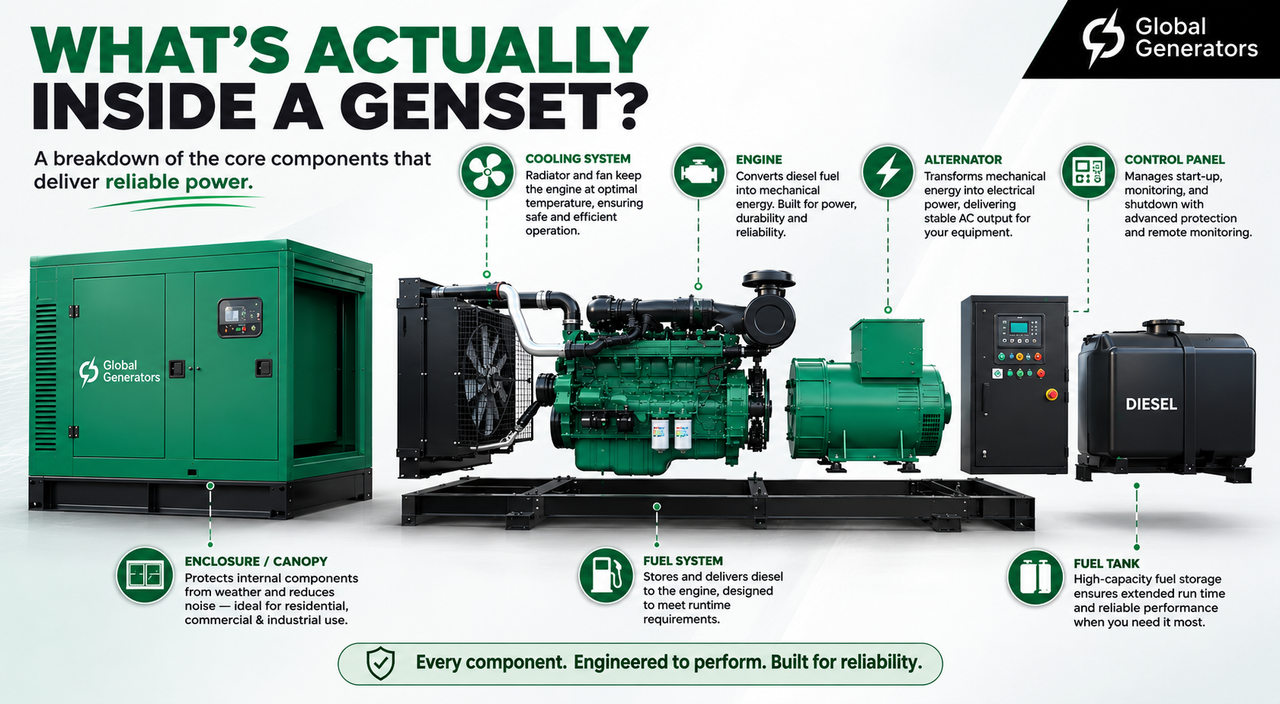 A genset brings together several core systems, each essential to reliable operation:
The engine is the power source, converting fuel into mechanical rotational energy. For DG sets, this is a diesel engine — commonly from established manufacturers producing everything from small single-cylinder units to large multi-cylinder industrial engines capable of powering an entire site.
The alternator converts that mechanical energy into electrical power, generating the AC output that actually supplies your equipment or building.
The control panel manages start-up, monitoring, and shutdown, and on most modern gensets also handles automatic switching, fault detection, and remote monitoring functions. Each of these core components is covered in more depth in our diesel generator parts guide.
The fuel system stores and delivers diesel to the engine, sized according to the genset’s expected runtime requirements.
The cooling system — typically a radiator and fan for smaller and mid-sized units — prevents the engine from overheating during operation, particularly important for units expected to run for extended periods.
The enclosure or canopy protects the internal components from weather and, in silent/acoustic models, significantly reduces operating noise — an increasingly important factor for gensets used in residential areas, hospitals, and commercial premises.
Every one of these systems needs to be correctly matched and sized to the others; a genset is only as reliable as its weakest linked component, which is why factory-built, tested units generally outperform ad-hoc assemblies.
What Are Gensets Rated By?
Once you understand what a genset is physically, the next question is usually how it’s rated and sized — and this is where terminology gets more technical.
Gensets are rated in kVA (kilovolt-amperes) and kW (kilowatts), and the difference between the two - governed by power factor - is one of the most common points of confusion for first-time buyers.
Gensets are also rated by duty type: standby, prime, or continuous, depending on how many hours a year the unit is expected to run and under what load conditions. Choosing the wrong duty rating for your actual usage pattern is one of the most common and costly specification mistakes, often leading to premature wear or outright failure.
Standby vs Prime: Why This Distinction Matters
A genset intended purely as emergency backup during grid outages has very different engineering requirements from one meant to serve as a site’s primary power source for extended periods. Running a standby-rated unit under prime-duty conditions — or vice versa — is a common and expensive mistake, which is why correct duty classification matters just as much as correct kVA sizing.
Silent vs Open: Choosing the Right Format
Beyond engine and rating, gensets also come in open (skid-mounted, unenclosed) and silent (acoustically enclosed) formats. The right choice depends heavily on where the unit will operate, local noise regulations, and proximity to occupied buildings — a genset destined for a construction site has very different requirements from one installed next to a hospital or residential property.
Why This Terminology Matters for Buyers
If you’re sourcing a genset — whatever term you use for it — from an international supplier, understanding this terminology helps in a few practical ways:
- You’ll read spec sheets and tender documents more accurately, regardless of which regional term the supplier uses.
- You’ll ask more precise questions about duty rating, fuel type, and enclosure format, rather than relying on the supplier to interpret a vague request.
- You’ll avoid mismatches between what you need and what gets quoted — a common issue when “genset,” “DG set,” and “generator” get used loosely across a conversation without anyone confirming duty type, kVA rating, or fuel type explicitly.
Final Words
A genset, a DG set, and a diesel generator are, in the overwhelming majority of cases, the exact same piece of equipment — a complete, engineered power generation unit combining an engine, alternator, controls, fuel system, and enclosure. The terminology differences are largely regional rather than technical, but knowing them helps you communicate more precisely with suppliers, read specifications correctly, and avoid the kind of terminology confusion that leads to mismatched quotes or incorrect equipment.
Whatever you call it, the fundamentals of choosing the right one stay the same: correct kVA and kW sizing, the right duty classification for your actual usage, and the right format for where it will operate.