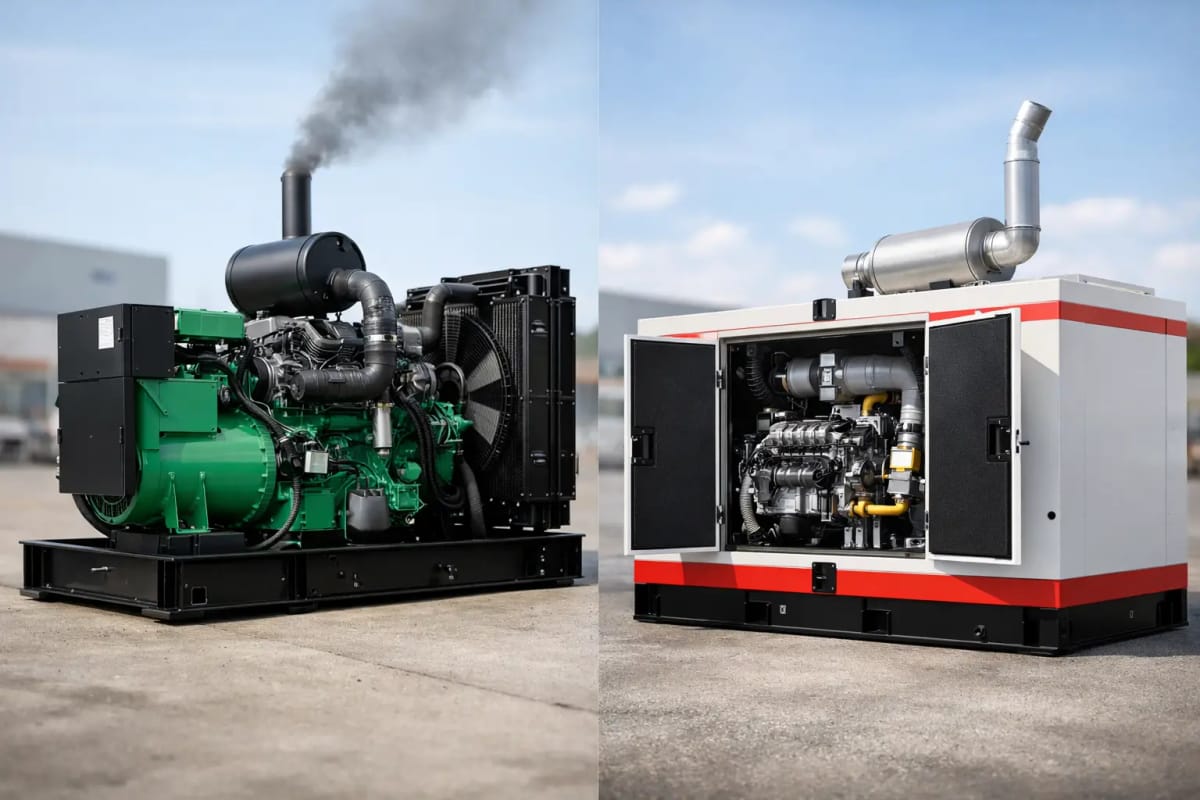
A diesel generator versus gas generator decision is not settled by fuel price alone. For a hospital, distribution centre, factory or infrastructure site, the practical question is whether the set will start, accept the load and continue operating when the normal supply has failed. Fuel resilience, duty cycle, site constraints and the consequences of a failed start should drive the specification.
Diesel and gas generator sets can both provide dependable power when correctly selected, installed and maintained. Their operating characteristics are different, however. Diesel remains the established choice for independent standby power and demanding prime-power applications, while gas can be a strong option where a secure piped fuel supply, lower local emissions and planned operating conditions align.
Diesel Generator Versus Gas Generator: The Core Difference
A diesel generator uses a compression-ignition engine supplied from an on-site diesel tank. A gas generator usually runs on natural gas from the mains network, although some sets can be configured for liquefied petroleum gas (LPG), biogas or dual-fuel operation. Natural gas and LPG should not be treated as interchangeable. Their fuel storage, supply pressure and operational risks differ significantly.
The central distinction is fuel independence. A diesel set with sufficient tank capacity carries its own energy source. It can operate through a grid outage without relying on the gas network. A natural-gas generator may have an effectively continuous fuel source in normal conditions, but its availability depends on pipeline integrity, gas pressure and the resilience of upstream infrastructure.
For sites where backup power must remain available during a wider utility failure, this difference matters. A data room, care facility, telecoms installation or water asset may not be able to accept an assumption that one utility will remain available while another has failed.
Standby Power and Emergency Load Acceptance
Standby generator duty is where diesel has a clear operational advantage. Modern diesel engines start quickly and typically respond well to sudden load steps. This is particularly valuable when an automatic transfer switch restores critical circuits containing motors, pumps, refrigeration equipment, lifts or uninterruptible power supply systems.
A diesel generator can be specified to carry a high proportion of its rated load promptly, subject to engine, alternator and control-system design. Its transient response is well understood and readily modelled during generator sizing. For emergency applications, that predictability is often more valuable than a marginal saving in fuel cost.
Gas engines can also provide reliable standby service, but load acceptance and start performance must be assessed carefully against the site load profile. They may need more consideration where large motor starts, rapid block loading or poor gas pressure are expected. A gas set should not be selected merely because natural gas is available at the property.
Fuel Storage Is Part of the Generator Specification
Diesel storage requires active management. Fuel has a finite shelf life, tanks need inspection, and water ingress or microbial contamination can compromise performance. A proper standby-power plan includes fuel polishing where required, periodic testing, tank monitoring and a defined refuelling arrangement. These are manageable obligations, not reasons to disregard diesel.
The benefit is control. A site can specify 8, 24, 48 or more hours of runtime at the expected load, then arrange fuel deliveries under its own emergency plan. For remote locations, construction projects and sites with weak utility infrastructure, that control is decisive.
Natural gas removes the need for bulk diesel storage and routine fuel deliveries. It can reduce the footprint associated with large tanks and avoid concerns around stored liquid fuel. However, the gas supply must be surveyed for pressure, flow rate, connection capacity and any contractual or network limitations. During a major incident, the site has no practical ability to replenish a disrupted gas network from its own stores.
Prime Power: Hours, Loading and Site Conditions
For prime-power operation, there is no universal winner. The correct choice depends on annual running hours, load variability, refuelling access, fuel cost and emissions requirements.
Diesel generators are commonly used for prime power on construction sites, mines, temporary compounds, remote facilities and industrial operations without dependable grid access. They are compact for their output, widely supported and available across a broad kVA range. An on-site fuel strategy is required, but diesel offers a proven route to continuous operation in locations where piped gas is unavailable.
Gas generator sets can be commercially attractive for high annual running hours where a stable natural-gas connection is present. Fuel costs may be lower and gas engines can support planned, steady-load operation effectively. They are also often considered for combined heat and power schemes, where recovered engine heat has a useful on-site purpose.
The qualification is loading. A generator should not be selected solely on its headline kVA. Project engineers need to establish the actual demand profile, starting currents, harmonic loads, altitude, ambient temperature and future expansion. Oversizing can lead to inefficient operation, while undersizing risks voltage and frequency instability, overheating and shortened engine life.
Standby Rating Is Not Prime Rating
A standby rating is intended for emergency use during a mains failure. A prime rating is designed for variable loads over extended operating periods. These ratings are not interchangeable, and the difference affects engine duty, permitted hours and expected loading.
Procurement teams should state the intended duty clearly at enquiry stage. A set required for annual testing and occasional emergency operation is specified differently from one expected to run daily or provide a site’s main electrical supply. Specifying the wrong rating can produce a lower purchase price but a poor long-term outcome.
Emissions, Planning and Noise Considerations
Gas is often viewed as the cleaner fuel at the point of use. Natural-gas engines can produce lower particulate emissions and, in many applications, lower carbon dioxide emissions than comparable diesel sets. This can assist where local air-quality requirements, planning conditions or corporate emissions objectives are material.
That said, emissions compliance is site-specific. The applicable requirements may depend on generator size, operating hours, location, exhaust arrangement and whether the set is for emergency standby or regular operation. Exhaust after-treatment, stack height, acoustic design and monitoring requirements should be addressed before equipment is ordered.
Diesel technology has also advanced substantially. Modern industrial sets can be supplied with suitable emissions equipment and enclosure options, but the package must be matched to the application. A silent canopy may be appropriate for a commercial estate or residential boundary, while an open set in a protected plant room may be the more practical format for an industrial site.
Noise is not determined by fuel type alone. Engine speed, enclosure construction, air intake and discharge attenuation, exhaust silencing, distance to receptors and installation layout all affect the final sound level. A properly designed acoustic solution is more reliable than selecting a generator based on a single quoted decibel figure.
Capital Cost, Running Cost and Whole-Life Risk
Diesel generator sets are generally available in a wide range of standard configurations, which can support faster procurement and delivery. Their capital cost can be favourable, particularly for standby applications. The cost model must include tanking, fuel management, maintenance, load-bank testing and refuelling logistics.
Gas generators may involve additional upfront work for gas connection design, pipework, pressure regulation, safety systems and site approvals. Where the set operates frequently, lower fuel costs can change the long-term calculation. Where it operates only during infrequent outages, the savings may not recover those installation costs.
The more useful comparison is whole-life risk. Calculate not only fuel consumption, but also the financial impact of a failed start, a delayed fuel delivery, restricted utility supply, planned maintenance, emissions controls and lost production. For a mission-critical site, the cheapest kilowatt-hour is rarely the only relevant metric.
When Diesel Is Usually the Better Choice
Diesel is normally the stronger option where the generator is a life-safety or business-continuity asset, where the site needs independent on-site fuel, or where large and rapidly changing loads must be supported. It is also well suited to remote, temporary and mobile applications, and to projects requiring a proven solution across smaller commercial through to multi-megawatt industrial capacities.
A diesel set is particularly compelling when a facility needs defined autonomy. If the requirement is 48 hours of independent standby operation at a known load, that capability can be engineered through tank capacity, fuel quality controls and a refuelling plan.
When a Gas Generator May Be the Better Choice
Gas may be the better choice for a site with a verified, resilient natural-gas supply, high running hours and a reasonably stable load profile. It can suit industrial facilities seeking to reduce local particulate emissions, projects with limited space for diesel storage, and combined heat and power installations.
The decision should follow a proper gas survey and load study. Confirm the available pressure and volume at the generator connection point, including the effect of other site gas users. Then test the operating case that matters most: what happens during a mains outage, at peak electrical load and under the lowest expected gas pressure?
Specify the Set Around the Failure Scenario
The best generator is the one designed around the outage your site is most likely to face. Establish the critical load, starting sequence, required runtime, fuel strategy, environmental conditions, noise limits and whether the duty is standby or prime. Then select the engine, alternator, control system, enclosure and ancillary equipment as one coordinated package.
For buyers comparing industrial options, Global Generators can assist with matching diesel generator capacity, configuration and rating to the operating requirement. A clear load schedule and runtime target will produce a more reliable recommendation than selecting by kVA alone.
Before issuing an order, ask a simple operational question: if the grid fails at the worst possible time, what fuel source, runtime and load response does the site need to keep working safely? The answer will usually make the generator choice clear.