A mains failure at a production line, data room, hospital facility or distribution centre is rarely just an inconvenience. It can stop output, compromise safety systems, damage stock and create contractual exposure within minutes. Energy resilience is the practical ability to keep essential operations running, safely and predictably, when the normal power supply is interrupted or unavailable.
For commercial and industrial operators, this is not solved by simply buying the largest generator available. It requires a power strategy built around actual loads, start-up currents, required run time, site conditions and a tested changeover arrangement. The right generating set is central to that strategy, but it must be specified as part of a complete system.
What Energy Resilience Means on Site
Energy resilience is the capacity to withstand, respond to and recover from a power disruption without unacceptable operational loss. For some sites, that means maintaining emergency lighting, fire systems and critical communications. For others, it means sustaining an entire process plant, cold store, telecoms installation or logistics operation until the grid returns.
The required level of continuity depends on the consequence of failure. A small commercial premises may only need selected circuits supported during an outage. A manufacturing plant may need controlled shutdown power for machinery, while a healthcare or infrastructure site may require automatic restoration to multiple essential loads with minimal interruption.
This distinction matters because it determines the generator rating, fuel storage, control system and switchgear required. Treating all backup power requirements as identical leads either to unnecessary capital cost or, more seriously, to a set that cannot perform when called upon.
Start With the Critical Load
The first specification question is not "what size generator?" It is "what must remain energised?" Separate essential loads from those that can be shed during an outage. This may include life-safety equipment, pumps, refrigeration, servers, security, process controls, loading systems and selected production equipment.
A proper load assessment should account for both running demand and starting demand. Motors, compressors, pumps and air-handling equipment can draw a significantly higher current when starting than when running. If several large motors start at once, a set sized only against steady-state kW can suffer a voltage dip, trip protective devices or stall the connected equipment.
Power factor, harmonic loads and future expansion also require consideration. Variable-speed drives, UPS systems and non-linear electronic loads can affect generator performance differently from conventional resistive loads. A competent specification allows sufficient capacity for these conditions rather than relying on a headline kVA figure alone.
Where a site is expected to grow, it may be more commercial to provide a generator with controlled spare capacity or design the installation for parallel operation later. The best route depends on load profile, space, budget and the cost of interruption.
Standby, Prime and Continuous Duty Ratings
Generator duty rating is a fundamental procurement decision. Standby-rated generators are intended to support a site during utility failure and usually operate for limited annual hours at variable load. This is appropriate for many offices, commercial properties and facilities with a reliable grid connection.
Prime power generators are designed for longer-duration or regular operation where utility supply is unavailable, unreliable or insufficient. They are commonly required for construction, remote sites, temporary infrastructure and applications with planned operational running hours.
A continuous-duty requirement is more demanding again and should not be assumed to match a prime rating. Operating a standby set as a regular source of production power can shorten service life, invalidate assumptions around maintenance intervals and create avoidable reliability risk. The selected rating must reflect how the set will actually be used.
Specify the Generator Around the Application
A generator set is not a generic commodity. Engine, alternator, control panel, enclosure, fuel arrangement and electrical configuration all affect suitability for the site.
Most industrial UK installations require 400/230V, 50Hz, three-phase power, but this should be confirmed against the existing distribution system. Smaller premises or specialist applications may require single-phase supply. Voltage, frequency, earthing arrangement and fault-level requirements should be reviewed before equipment is ordered, particularly where the generator connects to an established electrical installation.
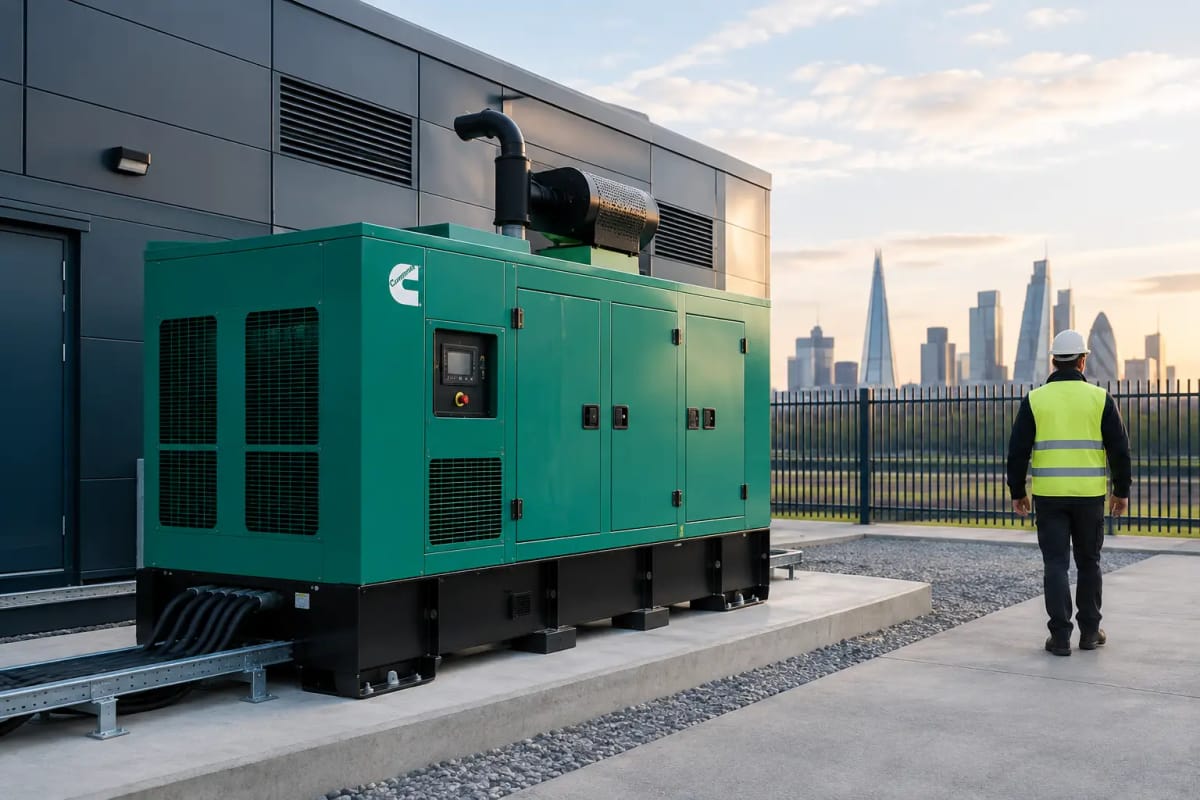
Cummins-powered diesel generators are widely specified for demanding standby and prime power duties because they provide proven engine technology across a broad output range. However, the engine brand is only one part of the decision. Buyers should assess the complete package, including alternator specification, controller capability, acoustic performance and service access.
An open generator set can be suitable for protected plant rooms or secure compounds where noise and weather exposure are controlled. A silent, weatherproof canopy is generally the better choice for external installations near workplaces, neighbours or public areas. The enclosure must still allow adequate ventilation, exhaust routing and access for routine inspection.
At larger capacities, physical logistics become critical. Confirm transport route, crane access, concrete base dimensions, exhaust clearances and fuel connection requirements before delivery. A well-specified generator cannot deliver resilience if it cannot be installed, maintained or refuelled safely.
Fuel Autonomy Is Part of the Power Plan
Generator run time is determined by fuel consumption at actual load, not by tank size alone. A set operating at 50 per cent load will consume fuel differently from one operating close to its maximum rating. Operators should define the outage duration they need to cover and calculate fuel autonomy with realistic loading, reserve margins and refuelling arrangements.
For a short-duration standby application, an integrated base tank may be sufficient. Sites exposed to prolonged grid disruption often require a bulk fuel tank, monitored fuel transfer system or formal refuelling contract. Hospitals, telecoms facilities and remote operations should also consider the practical availability of fuel during a regional incident, when normal transport routes and supplier capacity may be under pressure.
Diesel quality must be managed over time. Stored fuel can suffer from water ingress, contamination and microbial growth, all of which can restrict filters and prevent reliable starting. Fuel polishing, routine sampling and tank housekeeping should be built into the maintenance plan, particularly for sets that operate infrequently.
Automatic Changeover Determines the Response Time
A standby generator is only useful if critical loads transfer correctly. An automatic transfer switch, or ATS, monitors the mains supply, commands the generator to start and transfers the load once acceptable voltage and frequency are available. When utility power returns and stabilises, it transfers the load back under controlled conditions.
The switchgear design should reflect the required level of continuity. Some systems can tolerate a brief interruption during open-transition transfer. Others require synchronised or closed-transition arrangements to minimise disruption. UPS systems can bridge the start-up period for IT and sensitive electronic loads, but their interaction with the generator must be assessed rather than assumed.
Control panels should provide clear local indication, remote alarm capability and event history. For unmanned or multi-site estates, remote monitoring can identify low fuel, battery charger faults, failed start attempts and abnormal engine conditions before an outage exposes the problem.
Testing Turns Equipment Into Energy Resilience
The most common weakness in backup power provision is not the generator itself. It is lack of meaningful testing. A set that starts during a short no-load exercise has not proved it can carry the critical site load, accept motor starts or operate for the required duration.
Routine inspections should cover battery condition, coolant, oil, belts, heaters, charger operation, fuel level and signs of leaks or corrosion. Scheduled exercising confirms basic operation, while periodic on-load testing verifies performance under genuine demand. Where site testing is impractical, load-bank testing can provide a controlled alternative.
Testing should also include the transfer sequence, not just the engine. Confirm that the ATS starts the set, transfers the intended circuits, maintains stable voltage and returns the site to mains supply correctly. Record results, investigate anomalies and treat repeated alarms as a reliability issue rather than an administrative nuisance.
Maintenance frequency depends on duty, environment and manufacturer guidance. A generator in a dusty quarry, coastal compound or high-temperature plant room will need different attention from a lightly used set in a clean internal space. Critical equipment deserves a documented maintenance regime with clear ownership.
Procuring the Right Capacity and Configuration
A sound procurement process brings electrical load data, operating requirements and installation constraints together before selecting a model. Ask suppliers to state both standby and prime ratings clearly, identify assumed ambient conditions and confirm the alternator, controller, canopy and fuel-tank configuration included in the offer.
Price matters, but the lowest purchase price can become expensive if the set is incorrectly rated, unsuitable for the intended duty or unavailable when the project programme requires it. Stock availability is particularly relevant for replacement power after a failure, temporary works and time-sensitive construction programmes.
Global Generators supplies diesel generator sets from 13 to 3000 kVA, allowing buyers to match standby or prime power requirements with suitable open, silent, single-phase or three-phase configurations. For critical projects, an early technical enquiry is the efficient route to confirming capacity, format and delivery requirements before site works are committed.
Energy resilience is built before the outage, through accurate load assessment, correctly rated equipment, dependable fuel provision and testing that reflects real operating conditions. The practical objective is simple: when the mains supply fails, the site should continue exactly as its risk assessment says it must.